A small entryway can get messy surprisingly fast.
A few pairs of shoes by the door may not seem like a big problem at first, but once sneakers, sandals, work shoes, and everyday footwear start piling up, the entrance can quickly feel crowded.
The good news is that you do not need a large mudroom or built-in closet to keep things organized.
With the right shoe storage ideas for small entryways, even a narrow entrance can feel neat, welcoming, and easy to use.
Here are some simple ways to store shoes without taking over your entryway.
1. Use a Slim Shoe Cabinet
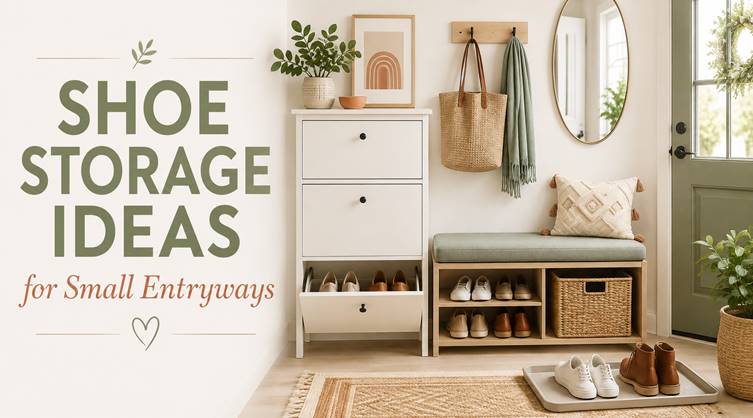
A slim shoe cabinet is one of the easiest solutions for narrow entryways.
Unlike traditional shoe racks, many slim cabinets store shoes vertically, which means they do not stick too far out from the wall.
This makes them especially useful in hallways and apartment entrances where every inch matters.
Look for a cabinet with a flat top so you can also use it as a small entryway console for keys, mail, or decorative items.
2. Choose a Shoe Storage Bench
A storage bench gives you two useful features in one.
You get somewhere to sit while putting on your shoes, along with storage underneath.
Depending on the style, the lower section may include open shelves, baskets, cubbies, or hidden compartments.
For a small entryway, choose a compact bench that leaves enough room to walk comfortably.
Add a cushion on top, and it can also make the entrance feel much more inviting.
3. Try a Vertical Shoe Rack
When floor space is limited, go upward.
A tall vertical shoe rack can store several pairs while using only a small section of the floor.
This works particularly well beside a door, inside a narrow hallway, or in an unused corner.
Choose a rack with a stable base, especially if it will hold heavier shoes.
4. Add Floating Shoe Shelves
Floating shelves can create storage without making a small entryway feel heavy.
Install a few shallow shelves close to the floor and use them for everyday shoes.
Because the shelves do not have bulky side panels, the area can feel more open.
You can also place hooks or a mirror above them to create a complete entryway station.
5. Use Baskets for Everyday Shoes
Sometimes the simplest solution works best.
A large woven basket can hold slippers, sandals, children’s shoes, or casual footwear that gets used regularly.
Baskets are especially helpful when you want shoe storage that does not look too much like storage.
Place one underneath a console table or bench, so the entryway stays tidy while still feeling warm and decorative.
6. Look for Furniture With Hidden Storage
If visible shoes make your entryway feel cluttered, hidden storage may be a better option.
A small storage ottoman, closed bench, or compact cabinet can keep footwear completely out of sight.
This is one of the most useful shoe storage ideas for small entryways because it helps the entrance look cleaner without adding too much furniture.
Hidden storage is also helpful if your entryway opens directly into the living room.
7. Use the Space Under a Console Table
Already have a console table near the entrance?
Use the empty space underneath it.
A low shoe rack, two matching baskets, or a few storage bins can fit neatly below the table.
This makes use of space that might otherwise sit empty.
For a more polished look, choose storage pieces that match the color and style of the console.
8. Add an Over-the-Door Shoe Organizer
If your entryway has a nearby closet, consider using the back of the door.
An over-the-door organizer can hold shoes without using any floor space at all.
This is especially convenient for:
- Flats
- Sandals
- Slippers
- Children’s shoes
- Lightweight sneakers.
It may not be the most decorative solution, but it is very practical when storage space is extremely limited.
9. Use Stackable Shoe Boxes
Clear or labeled shoe boxes make it easy to store footwear neatly while still knowing what is inside.
Stack them vertically inside a closet, underneath a console, or along a small section of wall.
Clear-front boxes are particularly convenient because you do not need to open several containers to find the pair you want.
Choose boxes with ventilation if shoes will be stored for longer periods.
10. Install Wall Hooks for Lightweight Footwear
Wall hooks are usually used for coats and bags, but certain styles can also hold lightweight shoes, slippers, or shoe bags.
They can be useful in very small entryways where even a narrow cabinet feels too bulky.
Just keep the arrangement simple so the wall does not start looking cluttered.
11. Create a Small Shoe Drop Zone
Not every pair of shoes needs to live by the front door.
One of the easiest ways to control clutter is to create a small drop zone only for the footwear you use most often.
For example, each family member could keep one or two everyday pairs near the entrance while the rest remain in bedroom closets.
This keeps your entryway functional without turning it into your entire shoe collection.
12. Use a Corner Shoe Rack
Corners are often overlooked in small entryways.
A compact corner rack can turn unused space into practical shoe storage.
Look for triangular or narrow shelving that fits neatly without blocking the walkway.
You can also place a plant or decorative basket on the upper shelf to make the storage feel more intentional.
13. Choose Adjustable Shoe Organizers
Adjustable racks are helpful because different shoes require different amounts of space.
Boots need more height than flats, while sneakers often take up more width.
An adjustable organizer lets you change the shelf spacing as your needs change.
This can be especially useful for families that need to store different types and sizes of shoes.
14. Store Seasonal Shoes Somewhere Else
One simple way to make a small entrance feel less crowded is to stop storing every pair there.
Winter boots do not need to take up space during summer, and sandals do not need to stay near the door throughout winter.
Use under-bed storage boxes, closet shelves, or labeled bins for seasonal footwear.
Then keep only your current everyday shoes in the entryway.
15. Keep a Shoe Tray Near the Door
A shoe tray is a small addition, but it can make a big difference.
It provides a designated place for wet, muddy, or dirty shoes so they do not damage your flooring.
This is particularly useful during rainy or snowy weather.
Choose a tray that is easy to wipe clean and large enough for the shoes your household uses most often.
Shoe Storage Ideas for Small Entryways With No Closet
Not having an entryway closet does not mean you have to live with shoe clutter.
Focus on furniture that uses minimal floor space.
A practical setup might include:
- Slim shoe cabinet
- Small storage bench
- Wall hooks
- Floating shelf
- Shoe basket
- Compact tray.
Try to keep the arrangement visually simple.
Too many different storage pieces can make a small entrance look busier than the shoes themselves.
How to Make Shoe Storage Look Stylish?
Storage should solve clutter, but it can also become part of your decor.
Try to repeat materials already used elsewhere in your home.
For example:
- Woven baskets for a warm, natural look
- Light wood for Scandinavian-inspired spaces
- Black metal for modern interiors
- White cabinets for small, bright entryways.
Adding a mirror, small lamp, artwork, or plant nearby can make the storage area feel like a designed entryway rather than simply a place to leave shoes.
Simple Shoe Storage Ideas for Small Entryways
If you do not want to spend much, start small.
You may only need:
- One shoe basket
- A compact rack
- A few wall hooks
- A shoe tray
- A small bench.
The important thing is giving your everyday shoes a designated place.
Once everything has a home, keeping the entrance tidy becomes much easier.
Final Thoughts
The best shoe storage ideas for small entryways are not necessarily complicated.
They simply make better use of the space you already have.
A slim cabinet can take advantage of a narrow wall. A bench can combine seating and storage. Baskets can hide everyday clutter, while vertical racks make use of space that would otherwise go unused.
Start with the shoes you use most often and create an easy place to store them near the door.
Once you stop treating the entryway as a temporary dumping spot, even the smallest entrance can feel calmer, cleaner, and far more welcoming.