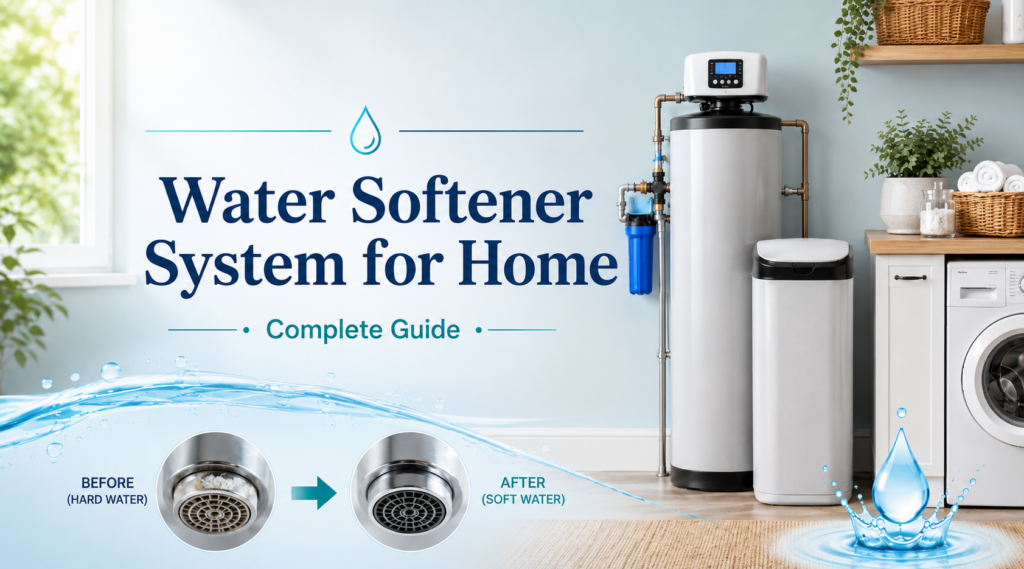
Have you ever noticed chalky white marks on your faucets, cloudy spots on freshly washed glasses, or a rough feeling on your skin after taking a shower? These are common signs of hard water.
Hard water is not usually dangerous to drink, but it can create several frustrating problems around the house. It may leave mineral deposits inside pipes, reduce the efficiency of water heaters, make laundry feel stiff, and force you to use more soap and cleaning products.
Installing a water softener system for home can help solve many of these problems by reducing the minerals responsible for water hardness.
However, choosing a water softener is not as simple as buying the first unit you find. Different systems use different technologies, capacities, regeneration methods, and maintenance requirements.
This complete guide explains how home water softeners work, their advantages and disadvantages, the different types available, how to choose the right size, installation requirements, maintenance needs, and much more.
What is a Water Softener System for Home?
A water softener system for home is a water treatment appliance designed to reduce hardness-causing minerals, mainly calcium and magnesium, from the water entering your property.
These minerals naturally dissolve into groundwater as it passes through rocks and soil. Although calcium and magnesium are not normally harmful, they can create scale deposits throughout your plumbing system.
A traditional water softener replaces calcium and magnesium ions with sodium or potassium ions through a process called ion exchange.
The result is softer water that:
- Produces better soap lather
- Leaves fewer marks on faucets and shower screens
- Reduces mineral buildup inside pipes
- Helps appliances operate more efficiently
- Makes cleaning easier
- Feels smoother on the skin and hair.
Most home systems are installed near the main water supply line so that softened water reaches almost every faucet and appliance in the house.
What is Hard Water?
Hard water contains high levels of calcium and magnesium. Its hardness varies based on local geology, water sources, treatment methods, and seasonal changes.
Hardness is commonly measured in:
- Parts per million, or ppm
- Milligrams per litre, or mg/L
- Grains per gallon, or GPG.
One grain per gallon is approximately equal to 17.1 milligrams per liter.
A general hardness scale looks like this:
| Water Hardness | Grains per Gallon | Approximate Condition |
| Less than 1 GPG | Very low | Soft water |
| 1–3.5 GPG | Low | Slightly hard |
| 3.5–7 GPG | Moderate | Moderately hard |
| 7–10.5 GPG | High | Hard water |
| Above 10.5 GPG | Very high | Very hard water |
The exact classification may vary slightly between organizations, but water above approximately 7 grains per gallon is usually considered hard enough to create noticeable household problems.
Common Signs You Have Hard Water at Home
Hard water often leaves visible signs, including:
- White scale around faucets, sinks, and showerheads
- Cloudy spots on glassware
- Soap and shampoo that do not lather easily
- Dry-feeling skin and dull hair
- Stiff towels and faded-looking clothes
- Reduced water pressure from mineral buildup
- Frequent scaling or repairs in water-using appliances.
How Does a Water Softener System for Home Work?
Most traditional water softeners use ion exchange and have three main parts:
- Resin tank: Contains resin beads that attract calcium and magnesium from hard water and replace them with sodium or potassium ions.
- Brine tank: Holds salt or potassium chloride used to clean and recharge the resin beads.
- Control valve: Manages water flow and starts the regeneration cycle when needed.
As water passes through the resin tank, hardness minerals are removed, allowing softened water to flow throughout the home.
What is Water Softener Regeneration?
Over time, resin beads become saturated with calcium and magnesium. Regeneration cleans and recharges them so the system can continue softening water.
The process includes:
- Backwash: Loosens sediment and cleans the resin bed
- Brine draw: Saltwater removes trapped hardness minerals
- Rinse: Flushes away minerals and excess brine
- Refill: Adds water to the brine tank for the next cycle.
Wastewater is sent through a drain line. Regeneration usually happens at night or during periods of low water use.
Benefits of Installing a Water Softener System for Home
The advantages of softened water can be noticed throughout the house.
1. Reduced Scale Buildup
One of the biggest benefits of a water softener system for home is reduced mineral scale.
Softened water can help limit deposits on:
- Faucets
- Showerheads
- Tiles
- Sinks
- Toilet bowls
- Glass shower doors
- Water heater components
- Internal plumbing surfaces
Existing heavy scale may not disappear immediately, but preventing further buildup can make long-term maintenance easier.
2. Improved Appliance Efficiency
Scale can form on heating elements and internal appliance components. Even a relatively thin layer may reduce heat transfer and make equipment work harder.
A water softener may help protect:
- Traditional water heaters
- Tankless water heaters
- Dishwashers
- Washing machines
- Steam appliances
- Coffee machines
- Ice makers
Actual energy savings vary depending on water hardness, appliance type, system condition, and household water use.
3. Easier Cleaning
Soft water helps soap and detergent work more effectively. You may find it easier to clean sinks, showers, bathtubs, tiles, and glass surfaces.
There may also be less need for frequent descaling and heavy scrubbing.
4. Softer Laundry
Clothes and towels washed in softened water may feel smoother because fewer minerals remain trapped in the fabric.
Detergents may also rinse more completely, helping fabrics maintain their softness and appearance.
5. Better Soap and Shampoo Performance
Because soft water does not react with soap in the same way hard water does, it usually creates lather more easily.
You may be able to use less:
- Shampoo
- Body wash
- Hand soap
- Dishwashing liquid
- Laundry detergent
- Household cleaner
It may take some time to adjust the amount you use. Using the same quantity as before can make softened water feel overly slippery or difficult to rinse.
6. Cleaner-Looking Fixtures and Glassware
Softened water generally leaves fewer visible mineral spots after drying.
This can improve the appearance of:
- Drinking glasses
- Cutlery
- Stainless-steel sinks
- Chrome fixtures
- Shower enclosures
- Kitchen appliances
7. Potentially Longer Plumbing Life
By reducing mineral accumulation, a water softener may help protect pipes, valves, fittings, and fixtures.
It cannot reverse every plumbing problem, but it may slow down additional scale formation.
What a Water Softener Does Not Remove?
A water softener is not the same as a complete water filtration or purification system.
A standard water softener primarily removes hardness minerals. It may reduce small amounts of dissolved iron in some cases, but it is not designed to remove every contaminant reliably.
A typical softener does not necessarily remove:
- Bacteria
- Viruses
- Chlorine
- Pesticides
- Fluoride
- Nitrates
- Lead
- Arsenic
- Microplastics
- Dissolved salts
- Unpleasant tastes and odors
- Sediment
Depending on your water quality, you may need additional equipment such as:
- A sediment filter
- An activated carbon filter
- An iron removal system
- An ultraviolet disinfection unit
- A reverse osmosis system
- A whole-house filtration system.
Water should be tested before choosing treatment equipment, especially when the home uses private well water.
Types of Water Softener Systems for Home
Different systems treat hard water in different ways. Some remove hardness minerals, while others mainly reduce scale buildup.
1. Salt-Based Ion-Exchange Water Softener
This system uses salt and resin beads to remove calcium and magnesium from water.
Best for:
- Moderate to very hard water
- Homes with scale buildup
- Protecting plumbing and appliances.
Advantages:
- Removes hardness minerals
- Provides genuinely softened water
- Works across different hardness levels.
Disadvantages:
- Requires salt refilling
- Uses water during regeneration
- Needs drainage and regular maintenance.
2. Potassium Chloride Water Softener
This ion-exchange system uses potassium chloride instead of sodium chloride to remove hardness minerals.
Best for:
- Households avoiding added sodium
- Homes that want traditional softening
- Compatible ion-exchange systems.
Advantages:
- Removes calcium and magnesium
- Adds potassium instead of sodium
- Works with many standard softeners.
Disadvantages:
- More expensive than regular salt
- May require higher doses
- System settings may need adjustment.
3. Dual-Tank Water Softener
A dual-tank system uses two resin tanks, allowing one tank to operate while the other regenerates.
Best for:
- Large households
- Homes with high water use
- Properties needing continuous soft water.
Advantages:
- Provides uninterrupted softened water
- Handles high water demand
- Offers consistent performance.
Disadvantages:
- Costs more
- Requires additional space
- Has more components to maintain.
4. Cabinet-Style Water Softener
This compact system combines the resin tank and brine tank inside one cabinet.
Best for:
- Small homes
- Apartments with suitable plumbing
- Limited installation spaces.
Advantages:
- Compact and tidy
- Easy to fit in small areas
- Attractive enclosed design.
Disadvantages:
- Limited capacity in some models
- Harder to access for repairs
- Salt refilling may be less convenient.
5. Portable Water Softener
Portable systems are small, movable units designed for temporary or low-volume use.
Best for:
- Recreational vehicles
- Boats
- Car washing
- Temporary applications.
Advantages:
- Compact and portable
- Easy to connect
- Useful for occasional use.
Disadvantages:
- Lower capacity
- Requires frequent regeneration
- May need manual operation.
6. Salt-Free Water Conditioner
A salt-free conditioner changes how hardness minerals behave instead of removing them from the water.
Best for:
- Mild to moderate scale problems
- Low-maintenance households
- Areas with softener discharge restrictions.
Advantages:
- Requires no salt
- Produces little or no wastewater
- Needs minimal maintenance.
Disadvantages:
- Does not remove hardness minerals
- May not work well with very hard water
- Does not provide the same soap and laundry benefits as soft water.
7. Magnetic or Electronic Descaler
These devices attach to water pipes and use magnetic or electrical fields to reduce mineral attachment.
Best for:
- Small-scale treatment needs
- Homes wanting a simple installation
- People exploring low-maintenance options.
Advantages:
- Easy to install
- Requires no salt
- Produces no regeneration wastewater.
Disadvantages:
- Does not remove hardness minerals
- Results may vary
- Should not be considered equal to an ion-exchange softener.
Water Softener vs Water Conditioner
These terms are often used interchangeably, but they are not always the same.
| Feature | Traditional Water Softener | Salt-Free Water Conditioner |
| Removes calcium and magnesium | Yes | Usually no |
| Reduces measured hardness | Yes | Usually no |
| Requires salt | Yes | No |
| Uses water during regeneration | Yes | Usually no |
| Requires a drain | Usually yes | Usually no |
| Helps soap lather | Yes | Limited change |
| Controls scale | Yes | May help reduce attachment |
| Maintenance level | Moderate | Low |
Your choice depends on whether you want true soft water or mainly want to reduce scale formation.
Water Softener vs Whole-House Water Filter
A water softener and a whole-house filter solve different problems.
A water softener targets calcium and magnesium.
A whole-house filter may target:
- Sediment
- Chlorine
- Odours
- Organic compounds
- Iron
- Specific chemical contaminants.
Many homes benefit from using both systems.
For example, a sediment or carbon filter may be installed before the water softener to protect the resin and improve general water quality.
The correct order depends on the contaminants present and the type of equipment being used.
How to Test Water Hardness?
Before buying a water softener system for home, test your water using one of these methods:
- Test Strips: Dip a strip into the water and compare the color with the provided chart. It is quick and affordable, but only gives an estimate.
- Liquid Drop Kit: Add testing drops until the water changes color. This method usually provides a more accurate hardness reading.
- Laboratory Test: A certified lab can test hardness along with iron, manganese, pH, bacteria, metals, and other contaminants. It is especially useful for well water.
- Municipal Water Report: Your local water supplier may provide hardness information, but levels can vary by area and season. An at-home test is still recommended.
How to Choose the Right Water Softener System for Home?
Choosing the right water softener system for home depends on your water quality, household needs, and available space.
1. Water Hardness
The harder your water, the greater the system capacity you will need. Test your water hardness before choosing a unit.
2. Household Size
Larger households use more water and require a higher-capacity system. An undersized unit may regenerate too often, while an oversized one may cost more than necessary.
3. Daily Water Use
Consider the number of bathrooms, showers, laundry loads, dishwasher use, guests, and other water-consuming activities. Outdoor irrigation is usually kept separate to avoid wasting softened water.
4. Iron and Manganese Levels
Iron and manganese can reduce softener efficiency and stain fixtures. Higher levels may require a separate filtration system.
5. Flow Rate
Choose a system that can handle several fixtures running at the same time without reducing water pressure.
6. Regeneration Method
- Timer-based systems regenerate on a fixed schedule.
- Metered systems regenerate according to actual water use and are usually more efficient.
- Smart systems may include usage tracking, salt alerts, leak detection, and mobile controls.
7. Installation Space
Ensure there is enough room for the resin tank, brine tank, pipework, drain line, bypass valve, electrical outlet, salt refilling, and future servicing.
How to Size a Water Softener?
A basic sizing estimate uses three pieces of information:
- Number of people
- Daily water use
- Water hardness in grains per gallon.
The general calculation is:
Number of people × daily water use per person × hardness in GPG = daily softening requirement
For example, consider a four-person household using an estimated 75 gallons per person each day with water hardness of 12 GPG:
4 × 75 × 12 = 3,600 grains per day
If the goal is to regenerate approximately once per week:
3,600 × 7 = 25,200 grains
The home may need a system with enough practical capacity to handle at least this amount between regenerations.
However, advertised capacity can be misleading.
A system marketed as a “32,000-grain softener” may only reach that maximum capacity when using an inefficiently high amount of salt. Its more efficient operating capacity may be lower.
For accurate sizing, consider:
- Usable capacity at an efficient salt setting
- Iron concentration
- Peak flow requirements
- Desired regeneration frequency
- Resin volume
- Local water conditions.
A professional water treatment specialist can calculate these requirements more precisely.
Where Should a Home Water Softener Be Installed?
A whole-house water softener is usually installed where the main water line enters the building.
Common locations include:
- Garage
- Basement
- Utility room
- Mechanical room
- Well equipment area
- Enclosed outdoor utility space in suitable climates.
The unit is often installed after:
- The main shutoff valve
- The pressure tank in a well system
- A sediment pre-filter, when required.
It may be installed before:
- The water heater
- Indoor plumbing branches
- Certain whole-house filters, depending on system design.
Outdoor faucets used for gardening are often bypassed so that softened water is not used on plants or lawns.
The kitchen drinking-water faucet may also be left unsoftened or connected to a reverse osmosis system.
Can You Install a Water Softener Yourself?
DIY installation may be possible for someone with strong plumbing knowledge, the correct tools, and a straightforward installation location.
The work may involve:
- Cutting into the main water line
- Installing shutoff and bypass valves
- Connecting inlet and outlet pipes
- Installing a drain line
- Creating an air gap
- Connecting the brine overflow
- Programming the control valve
- Testing for leaks
- Following local plumbing rules.
Improper installation can cause leaks, drainage problems, contamination risks, water pressure issues, or equipment damage.
Professional installation is often the safer choice when:
- Plumbing needs major modification
- The home uses a private well
- Water pressure is unusual
- Drainage access is limited
- Local permits are required
- The system includes multiple treatment stages
- You are unfamiliar with plumbing codes.
What is a Water Softener Bypass Valve?
A bypass valve allows water to flow around the softener instead of through it.
This is useful when:
- The system needs servicing
- You are filling a swimming pool
- You are watering plants
- You need water while the softener is disconnected
- You want to test whether the softener is causing a pressure issue.
A good bypass arrangement makes maintenance much easier.
How Much Salt Does a Water Softener Use?
Salt use depends on water hardness, household consumption, resin capacity, regeneration settings, iron levels, and system efficiency.
A modern demand-initiated softener usually uses less salt than a timer-based model because it regenerates only when needed.
Sudden high salt consumption may indicate:
- Incorrect hardness settings
- Water leaks or a running toilet
- Excessive regeneration
- A faulty control valve
- Salt bridging
- Resin problems
- Increased household water use.
Types of Water Softener Salt
The most common salt options include:
- Evaporated Salt Pellets: Highly pure and leave less residue, making it suitable for many modern water softeners.
- Solar Salt Crystals: Made by evaporating seawater. It is affordable, widely available, and suitable for most residential systems.
- Rock Salt: Less processed and more likely to leave sediment in the brine tank, increasing cleaning needs.
- Potassium Chloride: A sodium-free alternative for compatible systems, but it is usually more expensive and may require a higher dosage.
Always use the salt type recommended by your water softener manufacturer.
Is Softened Water Safe to Drink?
For most healthy adults, properly softened water is generally considered acceptable for household use.
However, ion-exchange softening adds some sodium to the water. The amount depends on the original hardness level.
The harder the water, the more sodium may be added during the exchange process.
People following medically prescribed low-sodium diets should discuss softened drinking water with a healthcare professional.
Some households choose to:
- Leave the kitchen cold-water faucet unsoftened
- Install a separate drinking-water line
- Use potassium chloride
- Install reverse osmosis filtration at the kitchen sink.
Reverse osmosis can reduce sodium and many other dissolved substances.
Softened water should also be considered carefully when preparing infant formula. Follow medical and public-health guidance relevant to your situation.
Is Softened Water Good for Plants?
Softened water containing elevated sodium is not ideal for many plants, especially when used continuously.
Sodium can accumulate in soil and affect plant health.
It is usually better to water:
- Indoor plants
- Vegetable gardens
- Lawns
- Outdoor landscaping.
with untreated water, collected rainwater, or another appropriate source.
Many homes keep outdoor irrigation lines separate from the water softener.
Why Does Soft Water Feel Slippery?
People using softened water for the first time often say it feels slippery.
This does not usually mean soap is still on your skin.
Hard water creates mineral deposits and soap residue that can make the skin feel “squeaky.” Soft water allows soap to rinse more freely and leaves less mineral residue behind.
You may need to use less soap than before.
Reducing the amount of shampoo or body wash often improves the experience.
Possible Disadvantages of a Water Softener System for Home
A water softener system for home offers many benefits, but it also has a few drawbacks.
- Regular Maintenance: Salt-based systems need routine salt refilling, brine tank cleaning, and occasional servicing.
- Water Waste: Regeneration uses water and releases wastewater into the drain. Efficient systems reduce this waste but cannot eliminate it completely.
- Added Sodium: Ion-exchange softeners add a small amount of sodium to water, which may concern people following low-sodium diets.
- Installation Needs: Traditional systems require space for tanks, access to the main water line, a drain, an electrical outlet, and protection from freezing.
- Environmental Restrictions: Some areas regulate salt-based softeners because chloride-rich wastewater can affect the environment.
- Ongoing Costs: Additional expenses may include salt, electricity, regeneration water, cleaning products, replacement resin, repairs, and professional servicing.
Water Softener Maintenance Guide
Regular maintenance keeps your water softener efficient and helps extend its lifespan.
Check the Salt Level
Inspect the brine tank regularly and refill it before the salt runs out. Avoid overfilling unless recommended by the manufacturer.
Remove Salt Bridges
A salt bridge is a hardened layer that prevents salt from dissolving properly. Common signs include:
- Hard water returning
- Salt levels not decreasing
- Regeneration without improvement.
Carefully break the bridge using a blunt tool without damaging the tank.
Clean Salt Mush
Salt mush is a thick sludge that collects at the bottom of the brine tank and interferes with regeneration. Empty and clean the tank when the buildup becomes noticeable.
Clean the Brine Tank
Periodically remove sediment and salt residue. Place the system in bypass mode, follow the manufacturer’s instructions, rinse thoroughly, and dispose of old brine responsibly.
Use Resin Cleaner
Iron and manganese can reduce resin performance. Use a compatible resin cleaner as directed. High iron levels may require a separate filtration system.
Inspect the Drain Line
Check that the drain line is not blocked, kinked, frozen, disconnected, or submerged. A damaged drain line can prevent proper regeneration.
Test Water Hardness
Test softened water occasionally to confirm that the system is working correctly. Properly softened water should usually show very low hardness levels.
Schedule Professional Servicing
Arrange professional servicing if performance declines or the system is older. A technician can inspect the valve, resin, injector, seals, flow rate, drainage, programming, and water pressure.
How Long Does a Water Softener Last?
A well-maintained home water softener may operate for many years, but its lifespan depends on:
- Water quality
- System design
- Resin quality
- Maintenance
- Regeneration frequency
- Chlorine exposure
- Iron concentration
- Water pressure
- Installation quality.
The control valve and resin may wear out at different times.
Resin can gradually lose capacity due to age, chlorine damage, iron fouling, or physical breakdown.
In some cases, replacing the resin or control valve is enough. In others, replacing the complete system may be more practical.
Signs Your Water Softener is Not Working Properly
Watch for the following warning signs:
- Scale returning to faucets
- Soap no longer lathering well
- Water spots on dishes
- Laundry feeling rough
- Sudden change in water taste
- Brine tank overflowing
- Salt level never changing
- Excessive salt use
- Frequent regeneration
- Unusual noises
- Reduced water pressure
- Water remaining hard after regeneration
- Resin beads appearing in plumbing fixtures.
Before calling for service, check:
- Salt level
- Bypass valve position
- Power supply
- Time and hardness settings
- Drain line
- Salt bridge
- Recent water usage.
How to Improve Water Softener Efficiency?
A few practical changes can reduce salt use, water waste, and unnecessary regeneration.
- Use Demand-Initiated Regeneration: Choose a metered system that regenerates based on actual water use instead of a fixed schedule.
- Set the Correct Hardness Level: An incorrect setting can either allow hard water through or cause excessive regeneration.
- Repair Water Leaks: Fix leaking faucets, pipes, and toilets, as they can increase water use and make the system regenerate more often.
- Adjust the Salt Dose: Use an efficient salt setting based on the resin capacity and manufacturer’s instructions rather than always selecting maximum capacity.
- Bypass Outdoor Water: Do not soften water used for gardens, lawns, driveways, or other outdoor purposes.
- Install Water-Efficient Fixtures: Low-flow showers, faucets, and efficient appliances can reduce household water use and regeneration frequency.
Questions to Ask Before Buying a Water Softener
Before choosing a system, ask the supplier or installer:
- What is my exact water hardness?
- Has the water been tested for iron and manganese?
- What is the system’s usable capacity at an efficient salt setting?
- What peak flow rate can it handle?
- Is regeneration metered or timer-based?
- How much water does each regeneration cycle use?
- How much salt is expected per month?
- Is a pre-filter needed?
- Does the system include a bypass valve?
- What warranty covers the tank, valve, electronics, and labor?
- Are replacement parts easily available?
- Who will service the unit?
- Is the system certified by a recognized independent organization?
- Are there local restrictions on softener discharge?
- What ongoing maintenance is required?
Avoid choosing a system based only on the largest advertised grain number.
Final Thoughts
A water softener system for home can make a noticeable difference in everyday life. It can reduce scale, improve soap performance, make cleaning easier, protect water-using appliances, and help clothes and towels feel softer.
The most important step is choosing a system based on actual water conditions rather than advertisements alone.
Test your water, understand the hardness level, check for iron and other contaminants, calculate your household demand, and compare practical capacity and flow rate.
Remember that salt-based water softeners and salt-free conditioners are not the same. A traditional ion-exchange system physically removes hardness minerals, while most salt-free systems mainly aim to reduce scale attachment.
With the right system, correct installation, and regular maintenance, you can enjoy more manageable water and reduce many of the everyday problems caused by mineral buildup throughout your home.