When we bought our house, one of the first things we realized was that both bedrooms needed to be planned very carefully.
Our master bedroom measures approximately 10’2″ × 10’6″, while the second bedroom is around 10’9″ × 9’4″.
These dimensions are fairly common in apartments, but once you place a bed inside the room, the available floor space reduces very quickly. Add a wardrobe, side tables, or a dresser, and suddenly the room can start feeling crowded.
That was exactly what we wanted to avoid.
Instead of trying to fit more furniture into the bedrooms, we focused on creating storage in places that were already being used. The two solutions that worked best for us were:
- A properly planned wardrobe
- Storage underneath the bed
These simple choices helped us make better use of our small bedrooms without sacrificing too much walking space.
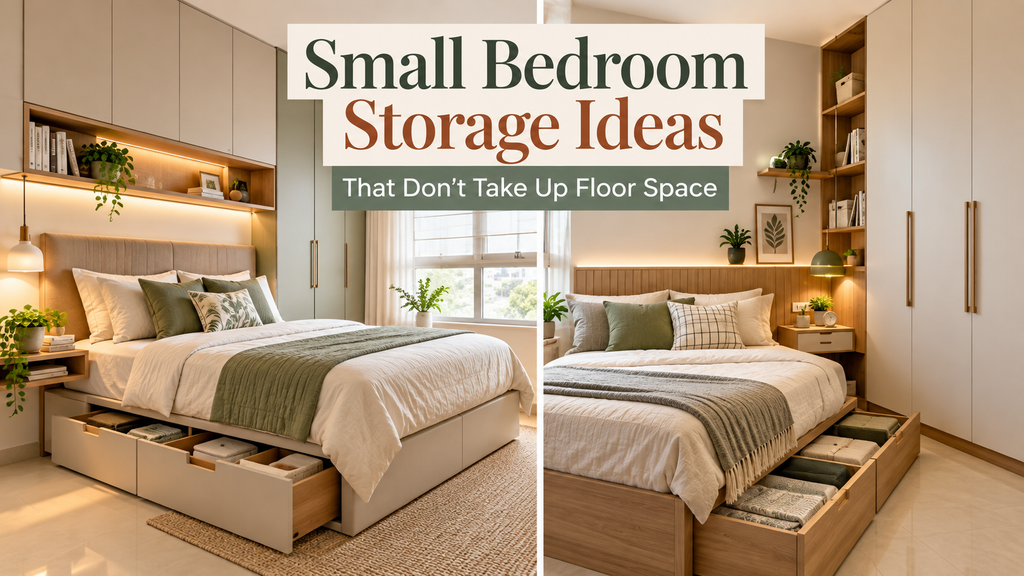
If you are also working with a compact bedroom, here are some practical small bedroom storage ideas based on what worked for us.
Our Small Bedroom Layout
Before planning the furniture, we looked carefully at the actual room dimensions.
Our master bedroom is approximately:
10’2″ × 10’6″
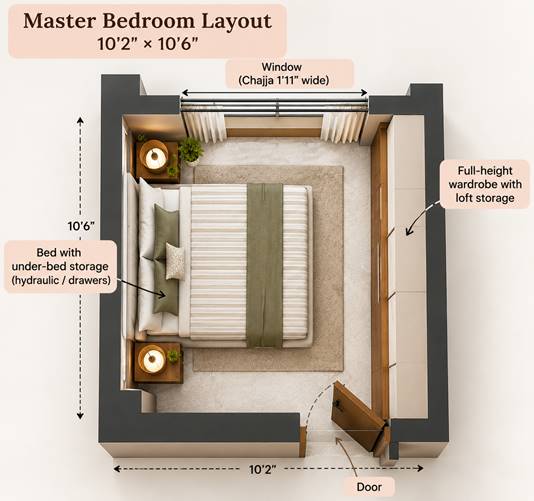
And our second bedroom measures around:
10’9″ × 9’4″
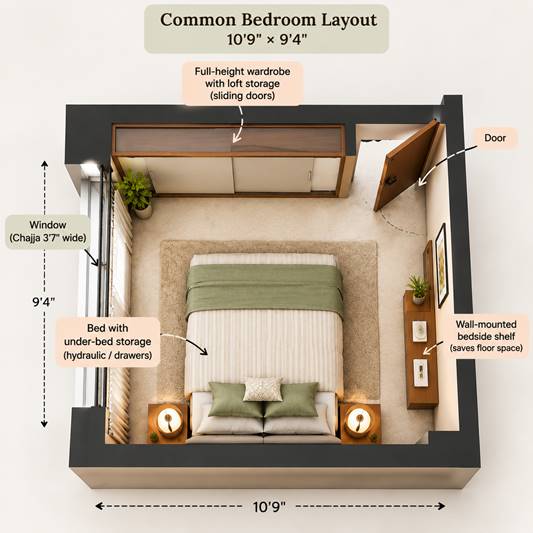
Looking at the floor plan made one thing very clear: there wasn’t enough space to keep adding separate storage units.
The bed already takes up most of the room.
So rather than asking, “Where can we put another cupboard?” we started thinking:
How can we get more storage from the furniture we already need?
That small change in thinking made a big difference.
Small Bedroom Storage Ideas
1. Make Under-Bed Storage a Priority
For us, under-bed storage was probably the most useful decision.
The bed is already going to occupy a large portion of a small bedroom, so leaving all the space underneath it unused felt like a missed opportunity.
Instead, we used the area below the bed for storage.
This space can be used for items such as:
- Extra bedsheets
- Blankets
- Comforters
- Seasonal clothes
- Travel bags
- Extra pillows
- Rarely used household items.
The best part is that none of this storage takes up additional floor space.
Why it Worked Particularly Well in Our Home?
Our second bedroom is only about 10’9″ × 9’4″.
If we had added a separate chest of drawers or another cupboard, the room would have become much tighter.
Under-bed storage gave us a large hidden storage area without making the room feel more crowded.
If you are buying or making a new bed for a compact bedroom, I would definitely recommend considering storage underneath it.
You can choose between:
- Hydraulic lift-up storage
- Drawer storage
- Box storage
- Storage beds with separate compartments
The best option depends on how often you need to access the items.
For things like blankets and seasonal clothes, even simple lift-up storage works very well.
2. Take the Wardrobe Upward Instead of Outward
When floor space is limited, vertical space becomes extremely valuable.
A wardrobe will occupy approximately the same amount of floor area whether it is six feet high or extends closer to the ceiling.
That is why using the upper portion of the wall makes sense.
If you are getting a wardrobe made specifically for your bedroom, consider extending it upward and creating loft-style storage at the top.
You can use the upper compartments for:
- Suitcases
- Seasonal clothing
- Extra bedding
- Travel bags
- Festival decorations
- Storage boxes
- Items you rarely use.
Keep your everyday clothes and accessories in the easily accessible middle section.
This helps you get much more storage without increasing the wardrobe footprint.
3. Avoid Filling a Small Bedroom With Too Many Furniture Pieces
One thing I have learned is that small bedrooms often become crowded not because they are badly designed, but because too many individual pieces of furniture are added.
It usually happens gradually.
- You start with a bed.
- Then you add a wardrobe.
- Then a bedside table.
- Then a dresser.
- Then a storage cabinet.
- Then maybe another shelf.
Every piece seems useful on its own, but together they can make a small room feel cluttered.
For bedrooms around 10 × 10 feet, I prefer fewer pieces of furniture that serve multiple purposes.
For example:
- A bed can also provide storage.
- A wardrobe can also include drawers.
- A wardrobe can include a dressing section.
- A headboard can include shelves.
- A wall-mounted shelf can replace a bedside table.
Before adding another piece of furniture, ask:
Can I create this storage within something that is already in the room?
That question alone can prevent a lot of unnecessary furniture.
4. Consider Storage Above the Bed
The wall above the bed is another area that often remains unused.
In a small bedroom, overhead cabinets can provide additional storage without taking up any floor space.
This can be useful for lightweight or less frequently used items.
However, I would recommend being careful with the design.
Very bulky overhead cabinets can make the bed area feel heavy.
If you want to use this idea, keep the cabinetry:
- Simple
- Light in color
- Shallow where possible
- Visually clean
The goal should be to add storage without making the room feel closed in.
5. Replace Bulky Bedside Tables With Wall-Mounted Shelves
Traditional bedside tables are useful, but in a small bedroom they can take away valuable walking space.
A simple floating shelf can do almost the same job.
You only really need a small surface beside the bed for things such as:
- Phone
- Charger
- Glasses
- Water bottle
- Book
- Small lamp
A floating bedside shelf keeps the floor underneath completely open.
That makes the room visually lighter and can also make cleaning easier.
If you need drawers, a small wall-mounted drawer unit is another option.
6. Plan the Inside of the Wardrobe Properly
A bigger wardrobe is not always the solution.
Sometimes the real issue is poor internal organization.
Before getting a wardrobe designed, think about what you actually own.
For example,
- Do you need more hanging space?
- Or do you mostly fold your clothes?
- Do you need drawers?
- Do you need a saree section?
- Do you need space for accessories?
- Do you want a section for bags?
- Do you need shoe storage?
The wardrobe should be planned around your actual habits.
A well-designed wardrobe can hold far more than a large wardrobe with badly placed shelves.
A Simple Approach That Works Well
Keep frequently used items around eye level.
Keep occasional items in the upper sections.
Use drawers for small items.
Use the lowest areas for heavier items or bags.
This makes the wardrobe much easier to use every day.
7. Consider a Storage Headboard
If your bedroom is too narrow for bedside tables, a storage headboard can be very useful.
Instead of having a completely decorative headboard, you can create shallow niches or shelves.
These can hold:
- Books
- Chargers
- Glasses
- Small decor
- Medicines
- Night-time essentials
Some designs even include hidden storage behind the headboard.
This lets the bed perform another function without using extra room.
8. Divide Storage Into Everyday and Occasional Items
One thing I learned after organizing our bedrooms is that storage needs to be convenient, not just available.
A space can technically hold a lot of things, but if it is difficult to access, it becomes frustrating.
I like to divide bedroom storage into two categories.
Everyday Items
These should be easy to reach.
For example:
- Daily clothes
- Nightwear
- Accessories
- Towels
- Frequently used bags
Occasional Items
These can go in less accessible spaces.
For example:
- Extra blankets
- Suitcases
- Winter clothes
- Festival clothes
- Travel accessories
- Spare bedding
These items are perfect for under-bed storage or upper wardrobe compartments.
This way, you don’t have to open heavy storage sections every day.
9. Measure the Walking Space Before Finalizing Furniture
This is something I think is especially important in a bedroom around 10 × 10 feet.
A few inches can actually make a noticeable difference.
Before ordering furniture, measure everything.
Consider:
- Bed width
- Bed length
- Wardrobe depth
- Wardrobe door opening
- Bedroom door opening
- Window position
- Curtain movement
- Electrical switches
- Walking space around the bed
A bed that is only slightly larger than necessary can reduce your walking space substantially.
The same applies to wardrobes.
If possible, mark the furniture dimensions on the floor before getting anything built.
You can even use masking tape to outline the bed and wardrobe.
Walk around it.
Open the door.
Stand where the wardrobe will be.
This gives you a much better idea of how the room will actually feel.
10. Consider Sliding Wardrobe Doors in Very Tight Rooms
If there is not enough clearance for wardrobe doors to open comfortably, sliding doors can be useful.
They do not require extra space in front of the wardrobe.
This can be particularly helpful if the bed is positioned close to the wardrobe.
However, sliding wardrobes have their own limitations.
You usually cannot access the entire wardrobe at once because one panel slides behind another.
So I would choose between hinged and sliding doors based on the actual room layout rather than assuming one option is always better.
11. Use Light Colors for Large Storage Units
Large wardrobes can visually dominate a small bedroom.
This is especially true when the wardrobe is tall or covers most of one wall.
Lighter finishes can help the room feel less heavy.
For example:
- White
- Off-white
- Light beige
- Pale wood
- Soft grey
Mirrored wardrobe shutters can also reflect light and make the room feel larger.
But mirrors are not necessary everywhere.
Even a simple, clean wardrobe finish can make a small room look much calmer.
12. Think About Storage Before Buying the Bed
If I had to give one suggestion to someone setting up a small bedroom from scratch, it would be this:
Choose your bed with storage in mind.
The bed usually has the largest footprint in the bedroom.
That means the space beneath it is one of the largest potential storage areas in the entire room.
Buying a standard bed and later realizing you need additional storage may force you to add another cabinet.
A storage bed solves that problem from the beginning.
13. Don’t Forget About Cleaning and Maintenance
This may sound like a small detail, but it makes a big difference over time.
Storage solutions should also be easy to clean.
Open shelves collect dust.
Open space above wardrobes collects dust.
Storage boxes beneath beds can become difficult to move.
That is why I prefer enclosed storage wherever possible.
Built-in wardrobes, closed lofts and bed storage keep things protected and make the room easier to maintain.
What Worked Best in Our Small Bedrooms?
After living with our bedroom layout, I would say the biggest difference came from two decisions.
Under-bed Storage
This gave us a large amount of hidden storage without consuming another inch of floor space.
A Properly Planned Wardrobe
Instead of depending on several different furniture pieces, the wardrobe became the main storage area for clothes and everyday belongings.
Together, these two solutions allowed us to avoid adding unnecessary cabinets.
In bedrooms measuring around 10 × 10 feet, that matters a lot.
The more open floor you can preserve, the more comfortable the room feels.
The Storage Rule I Would Use Again
If I were designing another small bedroom today, I would follow this order:
First: Use the space underneath existing furniture.
Second: Use vertical wall space.
Third: Improve the storage inside existing furniture.
Only then: Add another piece of furniture.
This approach helps prevent small rooms from becoming overcrowded.
Small Bedroom Storage Ideas at a Glance
If you are planning your own bedroom, these are some of the easiest ideas to consider:
- Choose a bed with built-in storage
- Extend wardrobes vertically
- Add loft storage
- Use floating bedside shelves
- Add limited wall shelving
- Use the back of the bedroom door
- Consider a storage headboard
- Improve wardrobe compartments
- Keep seasonal items at the top
- Use hidden storage wherever possible
- Avoid unnecessary freestanding cabinets
- Measure walking space before buying furniture.
You do not need to use every idea.
Even two or three well-planned solutions can make a noticeable difference.
Final Thoughts
Living with smaller bedrooms has made me realize that good storage is not really about fitting more furniture into a room.
It is about making better use of the space that is already there.
In our home, the master bedroom measures approximately 10’2″ × 10’6″, while the other bedroom is around 10’9″ × 9’4″.
Instead of trying to squeeze several storage units into these rooms, we focused on our wardrobe and under-bed storage.
That helped us keep more of the floor free while still creating enough room for our belongings.
If your bedroom is small, start by looking at the spaces that often get ignored:
- Under the bed.
- Above the wardrobe.
- Inside the wardrobe.
- Behind the door.
- And on the walls.
You may already have much more usable storage space than you think.
The goal is not to fill every available inch.
It is to create a room that gives you enough storage while still feeling comfortable, open and easy to live in.