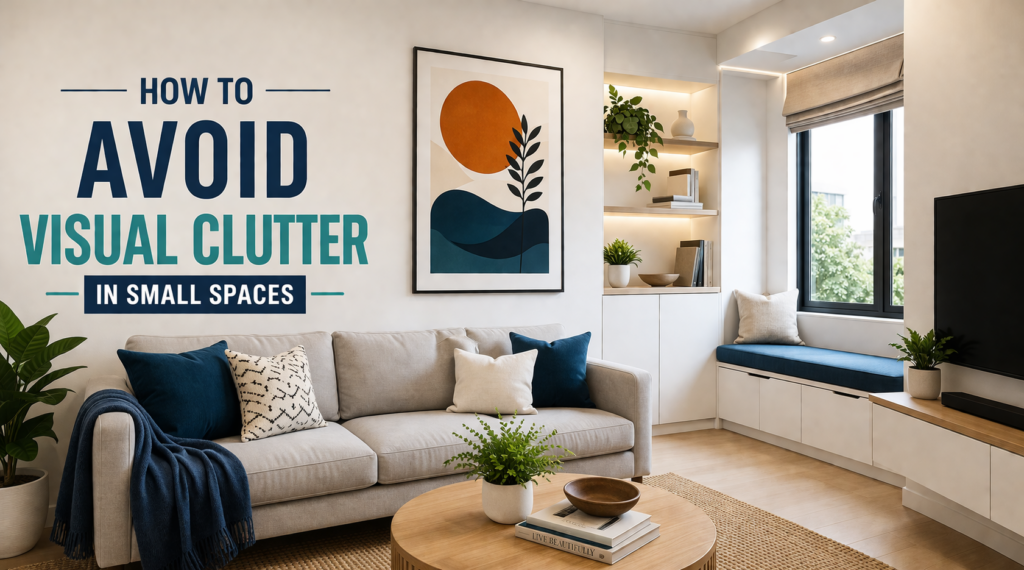
Small spaces can feel warm, personal and beautifully designed, but they can also become visually overwhelming very quickly. A few extra objects, too many colors, mismatched wall pieces or crowded surfaces can make even a thoughtfully decorated room feel smaller than it really is.
Visual clutter is not always about having too much stuff. Sometimes it comes from too many competing details. A room may be clean and organized, yet still feel busy because the eye has nowhere to rest. The good news is that small spaces do not need to be empty or overly minimal to feel calm. They simply need clearer choices.
Here are practical ways to reduce visual clutter in small spaces while still keeping your home personal, cozy and expressive.
Start With One Clear Mood for the Room
Before buying decor or moving things around, decide how you want the room to feel. Calm? Warm? Creative? Airy? Cozy? This helps you make better decisions about what belongs in the space.
Small rooms often become cluttered when they try to express too many styles at once. For example, a bedroom with bold bedding, colorful art, patterned curtains, open shelving and several decorative objects may include beautiful pieces individually, but together they can feel visually noisy.
A simple mood direction makes editing easier. If the goal is a calm bedroom, soft colors, simple wall art, natural textures and fewer visible objects will usually work better than high-contrast decor. If the goal is a creative home office, one bold focal point can work well, but the surrounding elements should stay quieter.
Choose Fewer Colors and Repeat Them Intentionally
Color is one of the biggest contributors to visual clutter. In a small space, too many unrelated colors can make the room feel fragmented. This does not mean everything needs to be beige or white. It simply means the palette should feel connected.
A useful approach is to choose one main neutral color, one or two supporting colors and one accent color used sparingly.
Repeating colors across the room creates rhythm. For example, if there is a soft green tone in a poster, it can be echoed in a cushion, plant or small decorative object. If the room has warm wood furniture, artwork with warm beige, cream, terracotta or muted brown tones can make the space feel more cohesive.
When colors repeat naturally, the room feels designed rather than crowded.
Give Your Walls Breathing Space
Small homes often rely on walls for personality, especially when there is limited floor space. Wall art, shelves, mirrors and hooks can all be useful, but too many wall elements can make a room feel busy.
A common mistake is filling every blank wall because empty space feels unfinished. In reality, blank space is what helps the eye relax. It gives important pieces more impact.
Instead of placing many small items across the walls, try choosing one stronger focal point. A single well-placed print above a desk, bed or sofa can make the space feel complete without overwhelming it. Curated poster prints and wall art from stores such as You Got Prints can work especially well when the artwork supports the room’s palette instead of competing with it.
In a small space, the question is not “How much can I fit on this wall?” but “What does this wall need to make the room feel balanced?”
Avoid Too Many Tiny Decorative Objects
Small decorative objects can be charming, but they can also create the fastest visual clutter. A shelf with ten small items often looks busier than a shelf with three larger, better-chosen pieces.
Try grouping smaller objects together instead of scattering them around the room. For example, place candles, small ceramics or keepsakes on a tray. This makes them feel like one intentional arrangement rather than many separate items.
Another useful rule is to vary height and shape. A small plant, a stack of books and one framed piece can look more composed than several objects of the same size. The goal is not to remove personality, but to display it in a way that feels calm.
Use Closed Storage Where Possible
Open storage can look beautiful in large, styled spaces, but in small rooms it can quickly become visually heavy. Books, cables, skincare products, office supplies, toys or kitchen items all add color, shape and texture. When everything is visible at once, the room feels busier.
Closed storage helps reduce visual noise immediately. Baskets, boxes, cabinets and drawers are simple tools for creating a calmer look. Even one closed storage solution can make a big difference in a small room.
For open shelves, keep only the most attractive or frequently used items visible. Leave some empty space between objects. A shelf does not need to be filled from end to end to be useful.
Choose Larger Pieces Instead of Many Small Ones
It may sound surprising, but small rooms often look better with fewer larger pieces than many small ones. This applies to furniture, wall art and decor.
For example, one medium or large artwork can feel cleaner than a cluster of many small frames. One substantial lamp can look better than several tiny light sources. One larger rug can make a room feel more grounded than multiple small rugs.
Many small items create many visual stopping points. Larger pieces simplify the room because the eye understands them more easily. This creates a sense of order, even when the space is compact.
Keep Surfaces as Clear as Possible
Tables, counters, desks and windowsills strongly affect how cluttered a room feels. When surfaces are crowded, the whole room can feel unfinished, even if the rest of the space is tidy.
A practical habit is to give every surface a clear purpose. A bedside table might only need a lamp, a book and a small tray. A desk might need a laptop, one notebook and a pen holder. A coffee table might need one decorative object and space for everyday use.
If an item does not support the function or mood of the surface, it may belong somewhere else.
Use Negative Space as Part of the Design
Negative space is the empty area around furniture, decor and artwork. In small spaces, it is one of the most important design tools.
A room with negative space feels calmer because the eye can move around without interruption. This can be as simple as leaving part of a wall empty, keeping space around a piece of art or avoiding too many objects on a shelf.
Negative space does not make a room look unfinished. It makes the chosen elements feel more intentional.
Be Careful with Patterns
Patterns can bring warmth and personality to a room, but too many patterns in a small space can create instant visual clutter. If there is a patterned rug, patterned cushions, patterned curtains and detailed wall art, the room may feel busy even if the colors are coordinated.
Choose one main pattern and keep the rest simpler. For example, if the rug is bold, choose quieter wall art and plain cushions. If the artwork is graphic or detailed, keep textiles softer and more neutral.
This balance lets pattern feel expressive rather than chaotic.
Edit Regularly, Not Dramatically
Reducing visual clutter does not need to be a one-time decluttering project. Small, regular edits are often more effective.
Every few weeks, look at one area of the room and ask:
Does this still belong here?
Does this add to the mood I want?
Is there too much happening in one spot?
Would this look better grouped, stored or moved?
Small spaces change with daily life. Editing regularly keeps the room feeling fresh without requiring a full redesign.
Final Thoughts
A small space does not need to be plain to feel peaceful. It can still include art, color, books, plants and personal objects. The key is to make fewer, clearer choices.
When the colors connect, the walls have breathing space, surfaces stay simple and each decorative piece has a purpose, even a compact room can feel calm and intentional. Avoiding visual clutter is less about removing everything and more about allowing the right things to stand out.